February 10, 2026
February is often framed around romantic love, but for mental health and well-being, relationships extend far beyond romance. For #UsapTayo, we shift the conversation toward a more inclusive and sustaining view of connection—one that recognizes the importance of our relationship with self, as well as with friends, family, and broader support systems.
At the core of all relationships is the relationship with oneself. Self-relationship involves self-awareness, self-compassion, and self-acceptance—protective factors strongly linked to psychological well-being. Research shows that self-compassion is associated with lower levels of depression and anxiety and greater emotional resilience (Neff, 2011). When we cultivate a kinder inner dialogue, we build a stable foundation that allows us to engage in healthier relationships with others.
Friendships also play a critical role in mental health, particularly across adulthood. Unlike romantic relationships, friendships often provide continuity, shared identity, and emotional safety without the pressure of exclusivity. Studies indicate that strong peer relationships are associated with reduced loneliness, better stress regulation, and improved life satisfaction (Holt-Lunstad et al., 2010). For many individuals—especially young people and older adults—friends become primary sources of emotional validation and belonging.
Family relationships, while complex, remain central to psychosocial development and coping. Supportive family environments are linked to better mental health outcomes, including lower psychological distress and improved recovery from adversity (World Health Organization [WHO], 2022). At the same time, it is important to acknowledge that “family” is not limited to biological ties. Chosen families—built through trust, care, and shared experience—can provide the same, if not stronger, protective effects for mental well-being.
Beyond personal relationships, broader support systems matter. Community groups, peer support networks, schools, workplaces, faith-based organizations, and mental health services all contribute to a person’s social safety net. Social support has been consistently identified as a buffer against stress, trauma, and mental health crises (American Psychological Association [APA], 2023). When people feel supported by systems around them, they are more likely to seek help early, adhere to treatment, and maintain hope during difficult periods.
Importantly, the absence of romantic partnership should not be equated with isolation or deficiency. Evidence suggests that the quality of relationships—rather than their type—is what most strongly predicts well-being (Holt-Lunstad et al., 2010). A person with strong friendships, meaningful family connections, and reliable community support can thrive just as much as someone in a romantic relationship.
For #UsapTayo, celebrating relationships beyond romance is also an act of inclusion. It validates diverse life paths and acknowledges that love, care, and connection take many forms. This perspective is especially important in mental health advocacy, where feelings of loneliness and social exclusion are major risk factors for distress and suicide (WHO, 2021).
As we broaden the narrative, we are reminded that mental well-being is relational. It grows through compassion toward self, consistency from friends, understanding within families, and safety offered by communities and systems. Beyond romance, these relationships sustain us, ground us, and help us heal. Through #UsapTayo, we continue to affirm that every form of healthy connection matters—and that no one’s worth is defined by their relationship status.
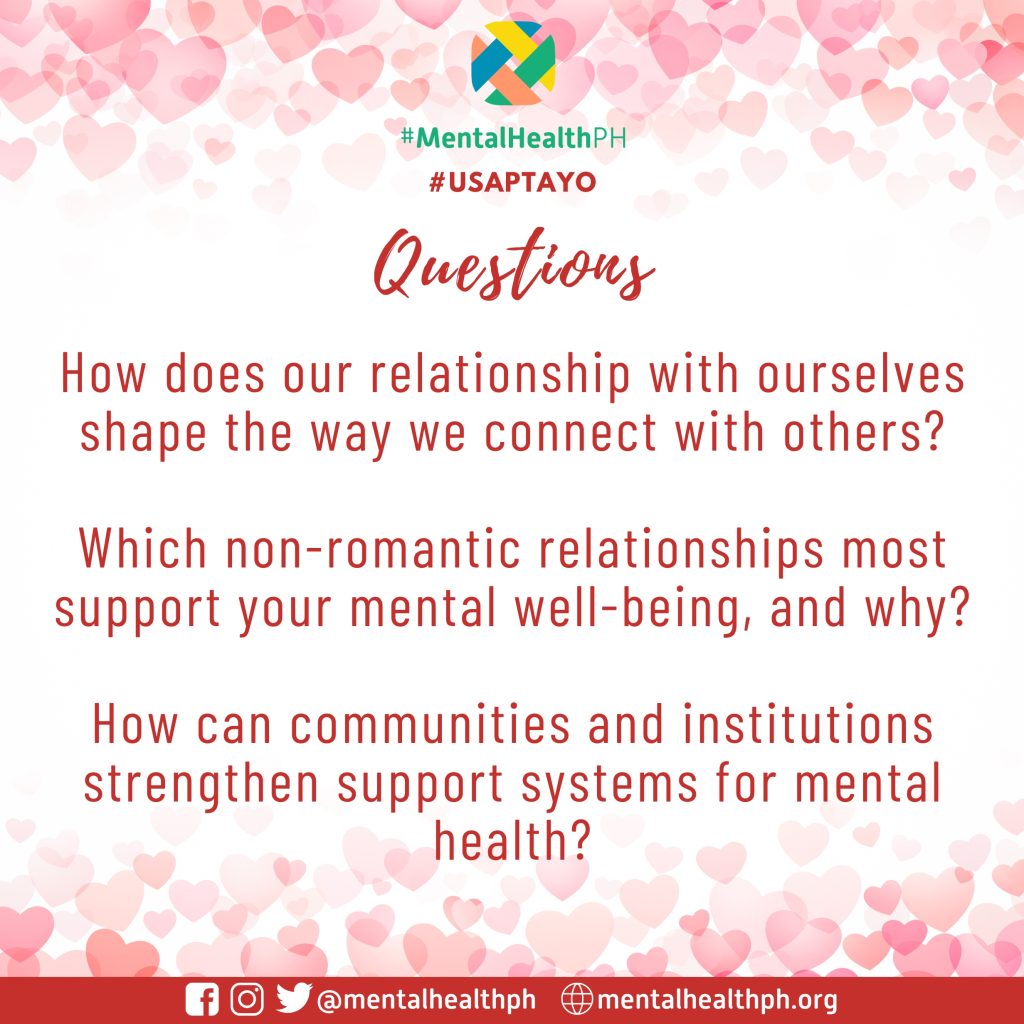
Questions:
- How does our relationship with ourselves shape the way we connect with others?
- Which non-romantic relationships most support your mental well-being, and why?
- How can communities and institutions strengthen support systems for mental health?
References:
American Psychological Association. (2023). Social support and mental health.
Holt-Lunstad, J., Smith, T. B., & Layton, J. B. (2010). Social relationships and mortality risk: A meta-analytic review. PLoS Medicine, 7(7), e1000316.
Neff, K. D. (2011). Self-compassion: The proven power of being kind to yourself. William Morrow.
World Health Organization. (2021). Suicide worldwide in the 21st century.
World Health Organization. (2022). Guidelines on mental health at work.