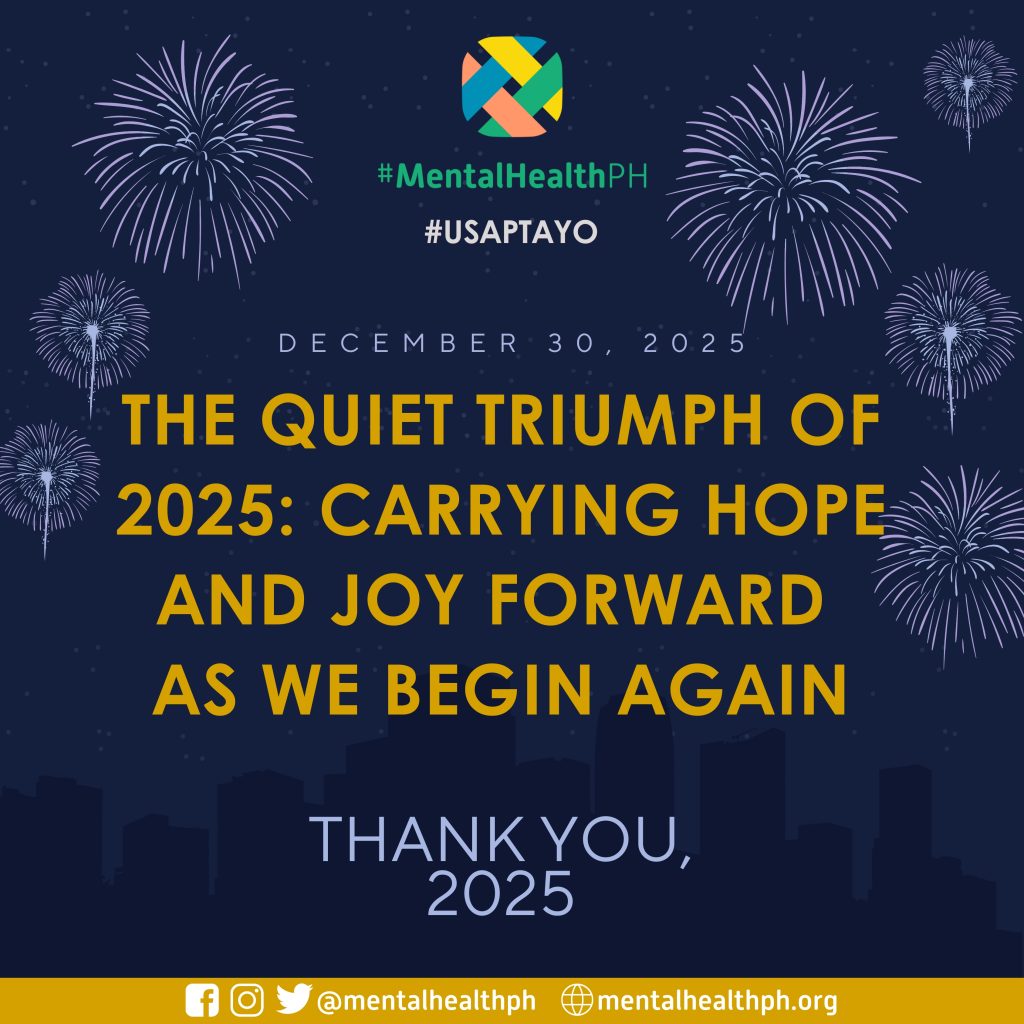
30 December 2025
Writer: Christopher Jan Dumaguin
Researcher: Christopher Jan Dumaguin
2025: The Year That Taught Us to Hold On, Then Rise
If 2025 had a voice, it would not shout. It would speak steadily, with the calm authority of a year that knew how much it asked of us and how much strength it quietly revealed.
This was not a year of easy wins. It was a year of endurance, discernment, and deep inner shifts. A year that did not simply pass through us, but stayed long enough to leave marks worth remembering.
Emotionally, 2025 tested patience. Many discovered that growth does not always arrive as clarity. Sometimes it comes disguised as confusion, waiting seasons, or unanswered questions. The year taught us that feeling lost does not mean being defeated. It often means being reshaped.
Professionally and academically, 2025 was demanding. Expectations grew heavier, timelines felt tighter, and the pressure to perform was real. Yet within that pressure, discipline was forged. Skills sharpened. Resilience quietly took root. Those who kept showing up learned that consistency, not brilliance, carries people across difficult years.
Personally, relationships were refined. Some connections deepened through honesty and shared struggle. Others faded, not out of bitterness, but out of necessity. 2025 reminded us that letting go is sometimes an act of respect for both parties involved.
2025 reminded us that strength is not always visible. Sometimes it looks like waking up despite exhaustion. Sometimes it sounds like choosing silence over reaction. Sometimes it feels like staying kind in a world that gives reasons not to be.
It taught us that progress is rarely linear. We can move forward while still feeling uncertain. We can heal while still remembering. We can succeed while still doubting ourselves. None of these contradictions cancel each other out. They coexist because growth is complex.
Most of all, 2025 reminded us to be human first. To rest without guilt. To ask for help without shame. To forgive ourselves for not knowing then what we know now.
The Quiet Breakthroughs That Mattered
The breakthroughs of 2025 were not always celebrated. Many happened privately.
A person finally chose themselves after years of postponement. Someone learned to say no without explanation. Another rediscovered faith, purpose, or direction after a long season of uncertainty. Some realized they were stronger than the circumstances they once feared.
These were not headline moments, but they were life-altering ones. 2025 broke patterns. It exposed what no longer worked. It pushed people out of comfort zones they had mistaken for safety. And in doing so, it made room for something truer.
A 2025 study from the University of Missouri shows that hope is more than mere optimism—it is a powerful contributor to mental health and resilience. Researchers found that individuals who report higher levels of hope also experience deeper life meaning, stronger coping skills, and better psychological functioning than those who rely on happiness or gratitude alone. This suggests that cultivating hope can be especially uplifting during transitional periods like the New Year, when people think about goals and future possibilities. [1]
In 2025, a global study tested a brief, accessible digital intervention designed to increase emotional well-being and positive emotions (a core aspect of joy). Participants engaged in simple daily activities (5–10 minutes), such as gratitude reflection or micro-well-being practices. Results showed meaningful improvements in positive emotions, happiness, perceived health, and reduced stress, especially among groups at higher risk of low well-being. This highlights how small, intentional practices can spark joy and emotional resilience as we enter a new year. [2]
A 2024 systematic review of research explored how dispositional hope and resilience work together to support mental health in diverse settings, particularly among young adults. The study found that higher levels of hope were strongly linked with better psychological adjustment, reduced anxiety and depression, and greater capacity to cope with stress. Hope also served as a predictor of resilience, suggesting it plays a key role not just in feeling good, but in enduring challenges and striving toward meaningful goals—ideal themes for a hopeful New Year. [3]
As 2025 closes its chapter, it does not demand applause. It leaves behind wisdom. It leaves the understanding that hardship does not negate hope. That delays are not denials. That becoming takes time, and that time is not wasted when it is used to grow.
2025 may not have been gentle, but it was honest. And honesty, though uncomfortable, prepares us for better days ahead. If there is one gift this year gives, it is this: We made it through. Wiser. More grounded. More capable than we were before. Stronger than we expect.
Step into the New Year with Trust
The New Year arrives like a quiet sunrise. Not with trumpets, but with light. It does not erase the road behind us; it illuminates the road ahead.
We come to this threshold carrying many things. Some are heavy with lessons, some are tender with gratitude, some still ache with unanswered prayers. Yet the beauty of a New Year is not that it promises a life without struggle, but that it invites us to begin again with clearer eyes and braver hearts.
Hope is the gentle courage to believe that what lies ahead can still be meaningful. It is choosing to plant seeds even when the soil has known drought. Hope whispers that growth is possible, even now, even here. Every morning of the New Year is a quiet vote of confidence in our capacity to rise, to learn, to love better than before.
Joy, on the other hand, is not loud or flashy. It often lives in small rooms. In shared meals. In laughter that arrives unexpectedly. In moments of peace when the world slows just enough for us to breathe. The New Year reminds us that joy is not postponed until life is perfect. It is discovered while life is unfolding.
This upcoming year does not ask us to be flawless. It asks us to be faithful to the journey. To keep going when the path bends. To rest when our spirit needs shelter. To celebrate progress, no matter how modest it seems. Every step forward counts. Every act of kindness matters. Every honest effort is a quiet victory.
Let the New Year be a season of gentler expectations and deeper purpose. Dream boldly, but walk patiently. Work diligently, but live gratefully. Forgive more easily, including ourselves. Choose hope when fear grows loud. Find joy even on ordinary days.
As the calendar turns, may we discover that the greatest gift of the New Year is not the promise of something new, but the reminder that we are still capable of becoming more than we were yesterday. That we still keep moving forward as we carry hope, joy, and trust in our hearts.


Session Questions:
- After all that 2025 has taught you, what kind of hope do you choose to carry forward, and how will you find joy even on difficult days?
- In a time when division, pressure, and uncertainty persist, how can hope and joy become deliberate choices that shape the way we speak, work, and treat one another in society?
- What small but meaningful actions can our community commit to this year to cultivate shared hope and sustain joy, especially for those who feel unseen or weary?
References:
Stann, E. 2025. Hope is the Key to a Meaningful Life, According to New Research. Show Me Mizzou. Retrieved at: https://showme.missouri.edu/2025/hope-is-the-key-to-a-meaningful-life-according-to-new-research
Guevarra, Darwin A. et al. 2025. Scaling a Brief Digital Well-Being Intervention (the Big Joy Project) and Sociodemographic Moderators: Single-Group Pre-Post Study. Journal of Medical Internet Research. Retrieved at: https://www.jmir.org/2025
Yan, Zheng et al. 2024. Resilience, Dispositional Hope, and Psychological Well-Being Among College Students: A Systematic Review. The Open Psychology Journal. Retrieved at: https://openpsychologyjournal.com/VOLUME/17