
May 20, 2026
Writer: Jossa Corpuz
Editor: Christopher Jan R. Dumaguin
You post a smiling photo. You caption it with something light, something funny, something that people may like without a second thought. You show up — to class, to work, to every conversation — with energy that people have come to expect from you. You are *that* person. The one who makes rooms feel warmer just by being in them.
Then you go home. Or maybe you find yourself sitting in the kind of silence that says too much. And suddenly, it all catches up to you. The weight you carried so gracefully in front of everyone else finally asks to be felt. No audience, no brave face, no need to explain. Just you, and it hits.
There’s a particular kind of exhaustion that nobody sees — the kind that lives underneath the version of you that the world knows. It’s not the tired you talk about. It’s the tiredness from holding yourself together when something inside you is pulling apart. From feeling a trigger land in your chest before your brain even has time to name it. From the sudden, unannounced spiral that doesn’t care that you have responsibilities, that people are counting on you, that you have a whole life to keep running.
Panic doesn’t wait for a convenient time. Neither does grief. Neither do the old wounds that never quite healed the way you told yourself they did. We’ve gotten so good at performing okay that we’ve almost convinced ourselves. Almost.
But there are moments — quiet ones, unexpected ones — when the performance slips and something small triggers something enormous. That when the emotion doesn’t ask for permission but it just takes us over. And in those moments, the most terrifying thing isn’t the feeling itself. It’s the fear that if you stop holding it together, everything will fall apart. That the people who believe in you, who look up to you, who think you have it all figured out — they’ll see the cracks.
Then you breathe. You compose yourself. You show up anyway. That takes more strength than most people will ever know. Because here’s what a typical day actually looks like — not the highlight reel, but the full thing:
You wake up already thinking about deadlines. School or work requirements that are due, a shift that starts in a few hours, content that needs to go up, messages that need a reply. You manage your own schedule, because you subconsciously think that’s just how it is. Nobody taught you how to do all of this at once. You just figured it out, quietly, along the way.
You sit in class and take notes while mentally drafting a work email in the back of your head. You clock in and give your full energy and attention to a job because you need it for yourself, for your finances, for the life you are building entirely with your own hands. You come home and there are no debriefs, no “how was your day,” no one waiting to ask if you’re okay. You just set your bag down, take a breath, and start again tomorrow.
Then you usually do all of this alone. Not because no one cares but because you made it look so manageable that nobody thought to ask if you needed help.
That’s the invisible part. The part that doesn’t make it into the caption.
There is the weight that doesn’t have a name people talk about openly. The one that comes with being the responsible one. The “ate.” The “kuya”. The child who doesn’t cause problems. The sibling who has it together so the others don’t have to worry.
Nobody handed you that title consciously. It just happened. But sometimes, in the quietest, most honest parts of yourself, there is something that feels like a hole. A hole that is hard to explain that is sometimes expressed in feeling angry. Not the kind you can scream out — the kind that sits heavy and unspoken, because how do you even begin to say it?
What is even harder to admit is that you feel most like yourself when you are away from them. Not because you don’t love them. You do — in a way that has cost you more than they will ever know. But when you step out that door — when you’re on your way to school, sitting in a classroom, walking somewhere alone, existing in a space that is just yours — something in your chest loosens.
You breathe differently. You feel lighter. Like you can just be a person, without the weight of a role you never asked for, without the quiet sting of being treated as less than, without having to be okay so that they don’t worry.
Why does coming home sometimes feel like bracing for something?
Somewhere along the way, you were made to feel that giving to yourself was selfish. That the right thing, the loving thing, was to pour out — even when you were running on empty. Even when they weren’t pouring back. Even when the treatment you received at home was nowhere near equal to what your siblings got, you still felt the pull to give. To prove your love. To earn, maybe, the fairness that was never freely given.
Keeping what you earn is not abandonment. Choosing yourself is not cruelty. Withholding from people who have not treated you fairly is not selfishness — it is the only boundary you have been able to draw, the only thing left that is entirely yours. That boundary, as quiet and invisible as it is, might be the first real thing you have ever done purely for yourself. It is how you begin to heal the version of you that was shaped by unfairness — the one who learned early that she had to work harder, be better, ask for less, and still be grateful. That version of you deserved more then. She still does now.
But here’s the thing to anyone who lives in this in-between space:
The version of you that’s still standing after every panic attack, after every spiral, after every moment where the emotion almost won — that version is real. That version is not weak. That version is doing something incredibly hard, and doing it quietly, and doing it over and over again.
Romanticizing your life isn’t denial. Finding beauty in ordinary moments isn’t pretending the pain doesn’t exist. It’s choosing, again and again, to also see the light — even when the dark is loud. You don’t have to choose between being the person people are inspired by and being someone who is struggling. Those two things can exist in the same body. On the same day and even in the same moment.
You don’t have to choose between loving your family and choosing yourself. But you are allowed to choose yourself without having to justify it to anyone. The bravest check-in is not “I’m fine.”
It’s the one you do with yourself, alone, when nobody’s watching. When you sit with the part of you that’s tired and you say: I see you. I know you’re there. We’re going to get through this. It’s the one where you stop asking yourself to disappear the hard parts and start asking: What do I actually need right now?
It’s the one where — maybe, slowly, on your own timeline — you let someone in. Not because you owe anyone your pain, but because carrying it alone forever was never actually the goal.
So, okay lang ba talaga? You don’t have to answer that for anyone else right now but in the hope you answer it for yourself. Honestly. Gently. Without judgment.
Being called the “strong one” was never meant to strip away your humanity. Strength was never about carrying every burden in silence or pretending pain does not exist. Even the people who seem unshakable are allowed to feel tired, to break, to pause.
Healing, as quiet and complicated as it often is, rarely moves in a straight line. Some days feel like progress, others feel like starting over. But perhaps healing looks like this: gently, fully, and quietly choosing yourself again, even after all the moments life taught you to choose everyone else first.
Ikaw din. Ikaw muna.
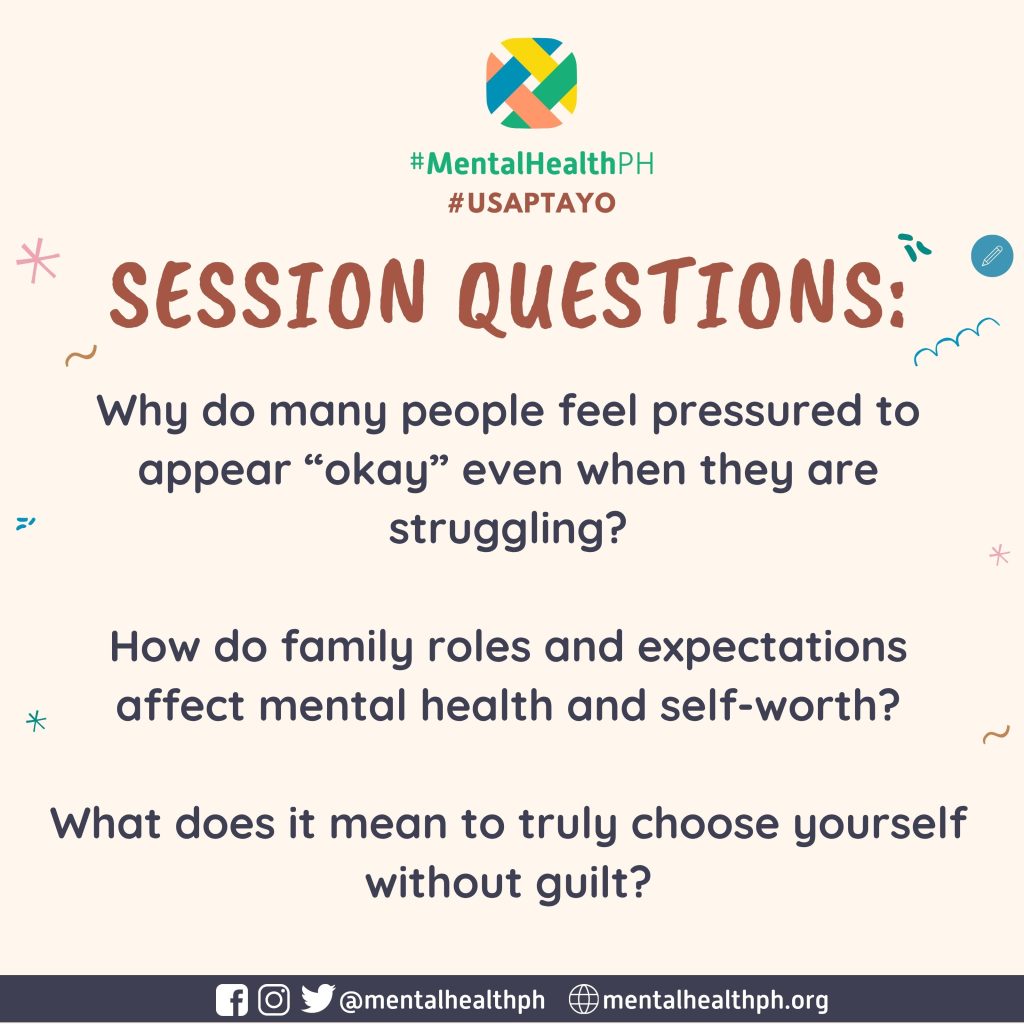
Session Questions:
- Why do many people feel pressured to appear “okay” even when they are struggling?
- How do family roles and expectations affect mental health and self-worth?
- What does it mean to truly choose yourself without guilt?