Every year, Earth Hour encourages people to turn off their lights for one hour to symbolize their care for the planet. However, for many individuals, especially those already experiencing heatwaves, floods, stronger storms, and ongoing environmental degradation, this gesture can feel insufficient. In response, Earth Hour has broadened the campaign’s framework, now promoting it as “Give an Hour for Earth,” moving beyond simply turning off the lights.
That discomfort is valid.
The climate crisis is not merely a symbolic issue; it goes far beyond awareness. The IPCC’s Sixth Assessment Report makes this painfully clear: climate change is caused by human activities, already impacting lives and ecosystems, and growing more dangerous with every increase in temperature.
This is why Earth Hour can resonate with some individuals while feeling pretentious or insufficient to others. Frustration with symbolic climate action is often not a sign of apathy; rather, it indicates an understanding of the problem’s magnitude. We recognize that turning off our lights for an hour does not equate to transforming energy systems, improving disaster response, regulating major polluters, redesigning urban areas, or protecting vulnerable communities. The crisis demands far more than mere gestures. But the emotional side of this matters too.
Living through the climate crisis can bring fear, helplessness, anger, guilt, and exhaustion. It can also cause solastalgia: the distress of seeing your home environment deteriorate while you are still living in it. It is the grief of watching familiar places become hotter, harsher, more damaged, or less safe. Research and public health bodies increasingly recognize climate change as a mental health issue, linked to anxiety, grief, distress, and trauma.
So this is not just a conversation about climate science or environmental campaigns. It is also a conversation about mental health.
What does it do to us when we are told to care deeply about the planet, but are only given small and symbolic ways to respond? What does it do to us when the burden of “doing something” is pushed onto individuals, while the real levers of power remain in the hands of institutions, industries, and governments?
That is why we need more than an hour.
We need more than gestures that make concern visible. We need climate action that is scientific, collective, and material: action that cuts emissions, protects communities, and responds to the crisis at the scale the science demands. We also need ways of coping that do not rely on denial, false optimism, or private guilt.
What to do about the climate crisis
- Push for rapid cuts in greenhouse gas emissions, especially in energy, transport, buildings, industry, and land use, because the IPCC identifies these as major sectors for mitigation.
- Support a shift away from fossil-fuel dependence and toward cleaner energy systems, since limiting warming requires deep reductions in energy-system emissions.
- Back public transport, walkable cities, and safer urban design, not just private “green choices,” because emissions are shaped by infrastructure and settlement patterns.
- Reduce food waste, which also cuts wasted land, water, labor, fuel, and methane-related emissions.
- Treat climate action as both mitigation and adaptation: cutting emissions while also preparing communities for heat, floods, storms, and other climate impacts that already affect health and safety.
- Support science-based climate policy, disaster preparedness, and climate-resilient public systems rather than relying solely on awareness campaigns.
- Keep asking who controls the biggest levers: energy systems, transport, land use, urban planning, industry, and public health systems. That is where large-scale change must happen.
How to cope in healthy ways
- Name what you are feeling honestly: fear, grief, anger, numbness, guilt, or solastalgia.
- Remind yourself that distress about the climate crisis is a reasonable response to a real threat to health, safety, and everyday life.
- Avoid carrying climate responsibility as though it belongs to you alone. The crisis is structural, even if your response can still matter.
- Stay connected to other people. Community support and shared action help make climate distress more bearable.
- Limit doom-scrolling and nonstop catastrophe exposure. Staying informed matters, but overwhelm can turn concern into paralysis.
- Stay involved in concrete, meaningful action. Action does not erase fear, but it can reduce helplessness.
- Keep a relationship with place: care for your neighborhood, your community, and the spaces that still matter to you.
- Let hope come from shared effort and material change, not from pretending the crisis is smaller than it is.
Earth Hour may still matter as a reminder that people want to care, and it should not end with the lights going off. If the hour opens a conversation, then that conversation should move toward something deeper: not just awareness, but accountability; not just symbolism, but solidarity; not just anxiety, but ways of coping that help us remain human in the middle of a crisis.
Because the climate crisis asks more from us than a performance of concern.
It asks for more than an hour.
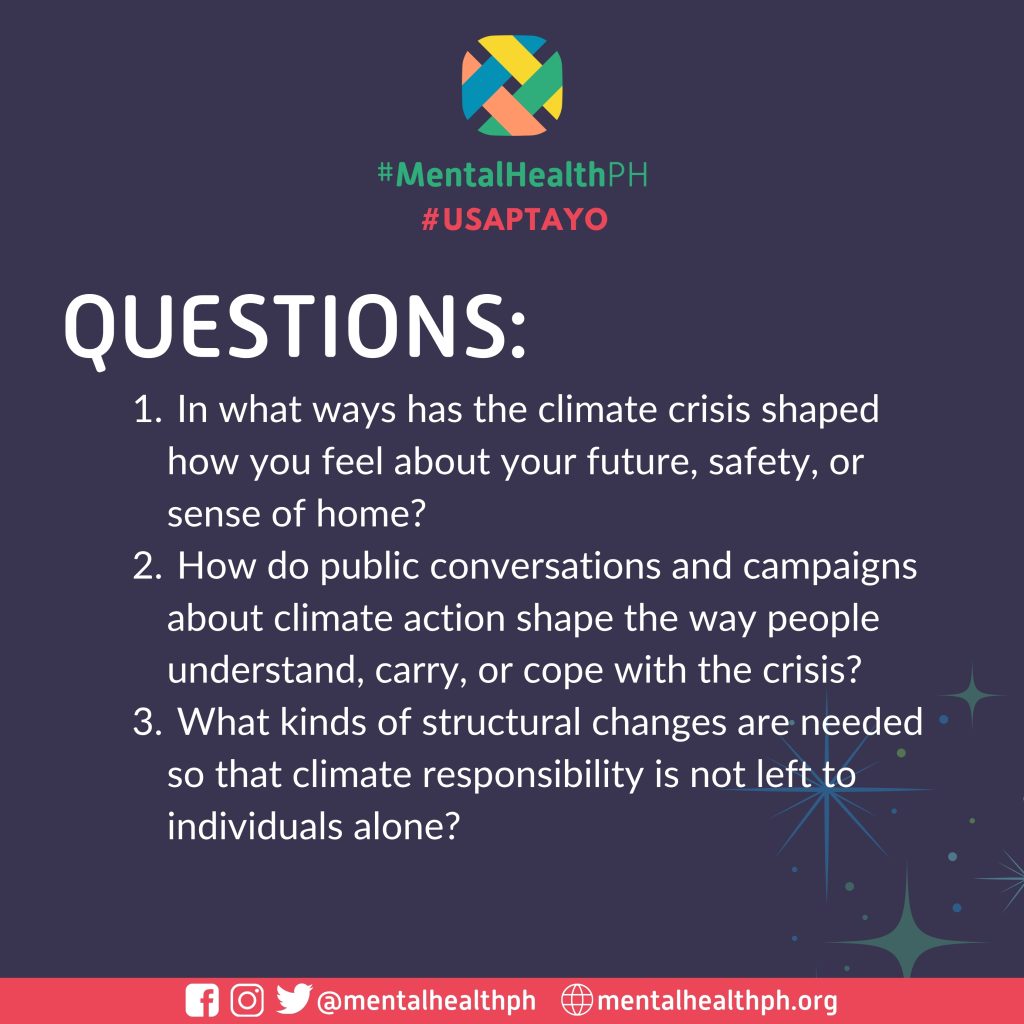
Questions:
- In what ways has the climate crisis shaped how you feel about your future, safety, or sense of home?
- How do public conversations and campaigns about climate action shape the way people understand, carry, or cope with the crisis?
- What kinds of structural changes are needed so that climate responsibility is not left to individuals alone?