Writer/ Researcher: Ysabella Yumul
Graphics: Jia Moral
As we finally wind down from the seemingly endless stretch of the holiday season, we start to see the reality of our surroundings with heightened clarity. The festive haze begins to lift, and the noise of celebration settles down. Suddenly, everyone is rushing back to their normal routine, but you struggle to catch up. Your space feels a bit too crowded and chaotic, while your energy is running on empty. The unchecked tasks on your to-do-list, the one-week-old leftover food in the refrigerator, the mountain of laundry at the corner, and the emails and messages left unread–it’s just one responsibility after another that you are dreading to go back to.
Yet, in the midst of this overwhelm, the pressure to build a “new you” continues to rise. We have been conditioned to believe that a “fresh start” requires rebranding your entire identity, changing habits and adding a few more to an already overflowing plate. Even on social media, we see a flood of posts tackling go-getting attitudes and zealous resolutions. But here’s the thing: you don’t need to do more to start over. What many fail to understand is that in life, sometimes the best way to move forward is to embrace less. Before we welcome another year with new goals and new habits, we should allow ourselves the space to breathe, removing what is unnecessary to make room for what’s next.
Build a Clean Slate
The easiest way to start your decluttering process is by focusing first on high-traffic areas, such as the kitchen island, the entryway table, or your work desk. Getting these “quick and easy wins” out of the way helps build the momentum, providing you with a hit of dopamine that transforms your sense of dread into fulfillment (Guardian Storage, 2025). Once you are able to make this first step, you find yourself no longer stuck. According to Pawelski, J. and Pawelski, S. (2023), research has found that cleaning up our physical surroundings often results in a clearer mind and better emotional well-being.
To continue moving forward, what you need now is discipline, not willpower. Develop a system that would make decluttering activity feel more intentional rather than exhausting. Understand that not every method will work for you, so adopt only the one that resonates with you (Metcalfe, 2026; Mortram, 2025). Some of the frameworks that you can apply are:
- KonMari
Recognized as one of the well-known methods of decluttering, Marie Kondo’s KonMari method highlights joy as the center of the process. This particular method follows a certain order of categories, which is believed to help ease the act of decluttering. Clothes come first, followed by books, paper, and last but not the least, komono or miscellaneous items. Kondo’s philosophy is that you should keep what “sparks joy” in your life. Otherwise, you thank it for the purpose it served then let it go.
- The Four-Box Method
This is arguably the most accessible and simplest method for anyone who is just starting out their decluttering journey. Often regarded as “the beginner’s method”, this framework involves four empty boxes and labeling each with their particular purpose. The most common labels are as follows: keep, throw away, donate, and sell. Once you have your boxes prepared, it is now time to go through your items and place them into the appropriate box. Evidently, this is as straightforward as it can go, although it does put emphasis on the crucial decision-making process.
- One in, One out
This particular policy is usually applied after you are done with your decluttering journey. It is a sustainable approach that keeps the volume of your belongings in check and helps you maintain your newly found clarity. The premise is simple: for every new item that enters your home, you remove an old one. By doing this, you prevent the slow creep of accumulation and guarantee that your space never exceeds its capacity again.
Silence the Guilt
There is what we call the “guilt-clutter”. These are items we keep out of obligation, such as expensive gifts we do not like or usually use or heirlooms that do not match our style. When dealing with these, we should always remember that a gift’s purpose is fulfilled the moment it is given. Keeping an item just ‘for the sake of it’ does not honor the giver; it only weighs down the receiver. As mentioned in an article written by Bulin (2026), “If everything is sentimental, nothing is sentimental.” Look at everything you have been holding onto so far and think, “Are all of these special to me?” Newsflash: The answer is no.
One thing you can do if you no longer want to keep a gift or an heirloom is ask if anyone in your family is interested in it. If no one wants it, then that is the time when you let it go, either by selling or donating it.
Release the Emotional Weight
Once you have cleared your physical clutter, you can now address the intangible ones. Now that we have finally reclaimed our space, it is crucial that we also find the time to keep our mental health in check and silence the internal noise. Are you the kind of person to hold a grudge, never let go of an old regret, or to impose a high expectation that you never managed to conquer? As you enter the new year, learn to release the internal burdens that have been keeping you awake at night and the ‘what-ifs’ that no longer serve you.
Enter the practice of “emotional decluttering”. According to Nimmo (2023), emotional decluttering is the act of “freeing ourselves from psychological baggage”. By identifying thoughts that cloud your clarity and weight down your spirit and choosing to leave them behind, you are granting yourself a clean slate mentally and emotionally. With a clearer and sharper bandwidth, you can finally welcome the new year and tune into its possibilities with a lighter heart and renewed grace.
Curate Your Future
As Murphy (2025) has put it, “At its core, decluttering is an act of liberation—an opportunity to untangle ourselves from the web of attachments that bind us to the past and restrict our sense of freedom in the present.” Every item we keep or carry with us possesses its own story and memory that may burden as time passes by. Not only that, but they also have the ability to influence our productivity and well-being (Curtis, 2025).
The act of decluttering may seem daunting at first but once accomplished, it can be one of the most rewarding tasks you will ever do for yourself. As you find yourself at the end of your decluttering journey, you will see the many things you have gained in return–clarity, energy, and room for growth–hence why psychologists often regard the activity as a symbol of a new beginning.
As we enter and welcome another year, let us remember to be kind and patient with ourselves. The starting point does not have to be grand nor loud; sometimes, it just has to do more with being less. Grant yourself a space that is not a museum of your old memories but a launchpad of your potential.

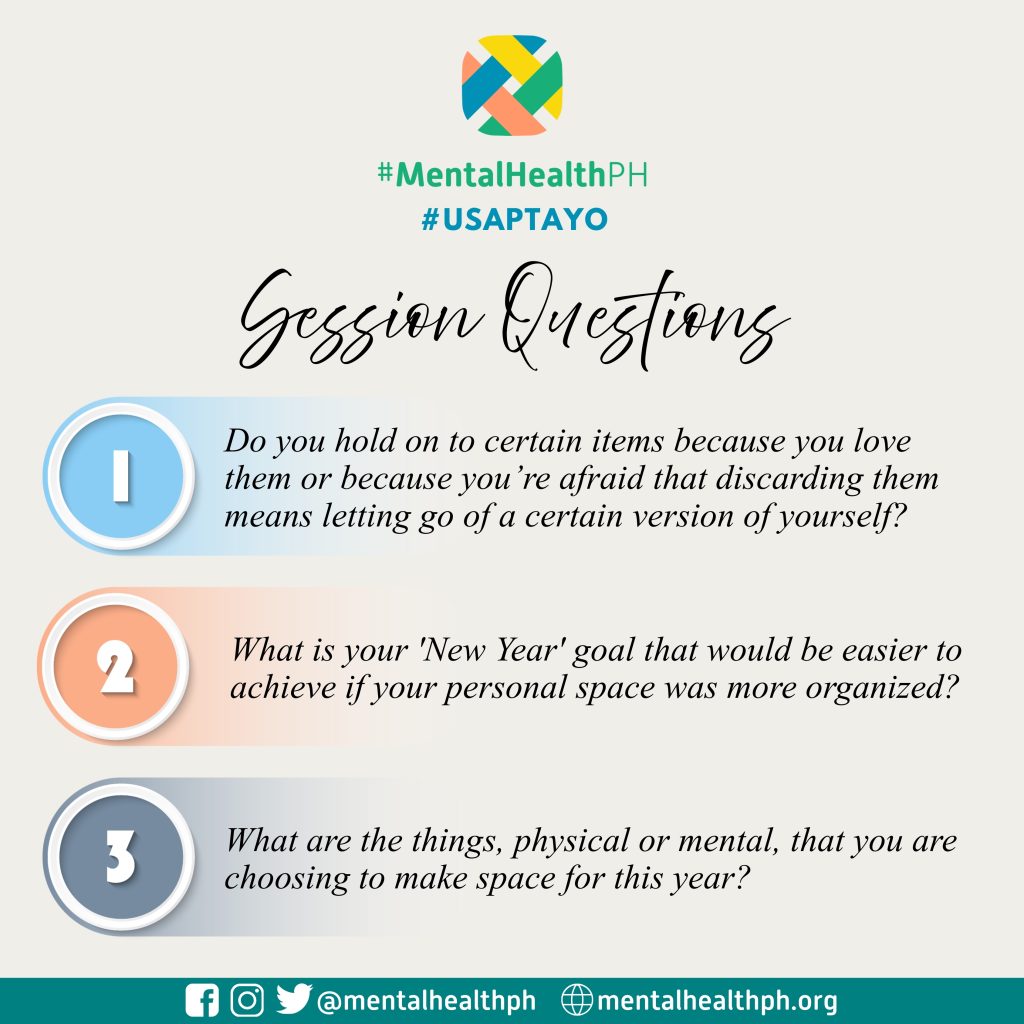
Questions:
- Do you hold on to certain items because you love them or because you’re afraid that discarding them means letting go of a certain version of yourself?
- What is your ‘New Year’ goal that would be easier to achieve if your personal space was more organized?
- What are the things, physical or mental, that you are choosing to make space for this year?
References:
Bulin, Q. (2026, January 4). 9 tips for decluttering sentimental items guilt-free. Southern Living. https://www.southernliving.com/decluttering-sentimental-items-11872911
Curtis, P. C. (2025, January 2). Creating space for the new: the power of decluttering. https://parkercolescurtis.com.au/blog/creating-space-for-the-new-the-power-of-decluttering
Guardian Storage. (2025, December 12). New year, fresh start: Declutter before 2026. https://www.guardianstorage.com/pre-new-year-decluttering/
Metcalfe, E. (2026, January 5). My house is chaos: where do I start? House&Garden. https://www.houseandgarden.co.uk/article/organise-declutter-house-for-happiness
Mortram, K. (2025, March 14). I write about decluttering for a living – these are my 7 favorite methods. Good Housekeeping. https://www.goodhousekeeping.com/home/organizing/a64179214/favourite-declutter-methods/
Murphy, M. (2025, April). The psychological impact of decluttering. https://www.michaelamurphy.co.uk/journal/the-psychological-impact-of-decluttering
Nimmo, K. (2023, December 31). Start your year with an emotional declutter. Medium. https://medium.com/on-the-couch/start-your-year-with-an-emotional-declutter-4efd39ba809a
Pawelski, J., PhD and Pawelski, S. P., MAPP. (2023, December 29). Why getting rid of things can change your life. Psychology Today. https://www.psychologytoday.com/us/blog/happy-together/202312/money-cant-buy-happiness-but-getting-rid-of-clutter-can