20 December 2025
Writer and Researcher: Valerie Rose V. Ferido
The holiday season is often framed as a time of joy, togetherness, and celebration. But for many, it can also magnify grief, loss, and longing—especially for those who are mourning people, relationships, or versions of life that no longer exist. In a culture that encourages constant cheer, grief is frequently sidelined, misunderstood, or rushed.
The holidays are often painted as a time of joy—bright lights, loud laughter, shared meals, and familiar traditions. But for many, this season can also magnify grief.
When someone you love is gone, the holidays don’t feel festive. They feel heavier. Empty chairs are louder. Songs hit harder. Even simple questions like “Kumusta ang pasko niyo?” can sting. And while the world seems to be celebrating, you may feel like you’re just trying to survive the day.
If you’re grieving this season, you’re not alone—and there is no “right” way to do this.
Grief doesn’t follow a holiday schedule
Grief doesn’t pause just because it’s December. It doesn’t shrink to make space for reunions or countdowns. In fact, it often grows louder during this time because the holidays are built around memory, connection, and presence—everything loss disrupts.
You might grieve a person who died. You might grieve a relationship that ended. You might grieve the version of life you thought you’d have by now. All of these are valid.
And no, grief is not linear. Some days, you’re okay. Some days, you’re not. Some days you laugh and feel guilty for laughing. Some days you feel numb. This doesn’t mean you’re doing grief “wrong.” It means you’re human.
Give yourself permission to feel—without forcing cheer
There is a quiet pressure during the holidays to be grateful, cheerful, and “okay.” But healing doesn’t require pretending.
You are allowed to:
- Say no to gatherings that feel too overwhelming
- Step out of the room when emotions hit
- Cry in the bathroom, in the car, or in bed
- Feel joy and sadness at the same time.
You don’t owe anyone a version of yourself that you don’t have the energy to be right now.
If the pain feels too heavy, ask for help
If grief begins to feel unmanageable—if you feel stuck, overwhelmed, or unsafe—it’s okay to seek professional support. Talking to a mental health professional can help you process what you’re carrying, especially during emotionally loaded seasons like the holidays.
Asking for help is not a failure. It’s a form of survival.
You don’t have to “move on.” You don’t have to be okay. You don’t have to meet anyone’s expectations of what healing should look like.
Getting through the holidays while grieving is already an achievement.
Be gentle with yourself. You are allowed to grieve—and you are allowed to keep going, one day at a time.
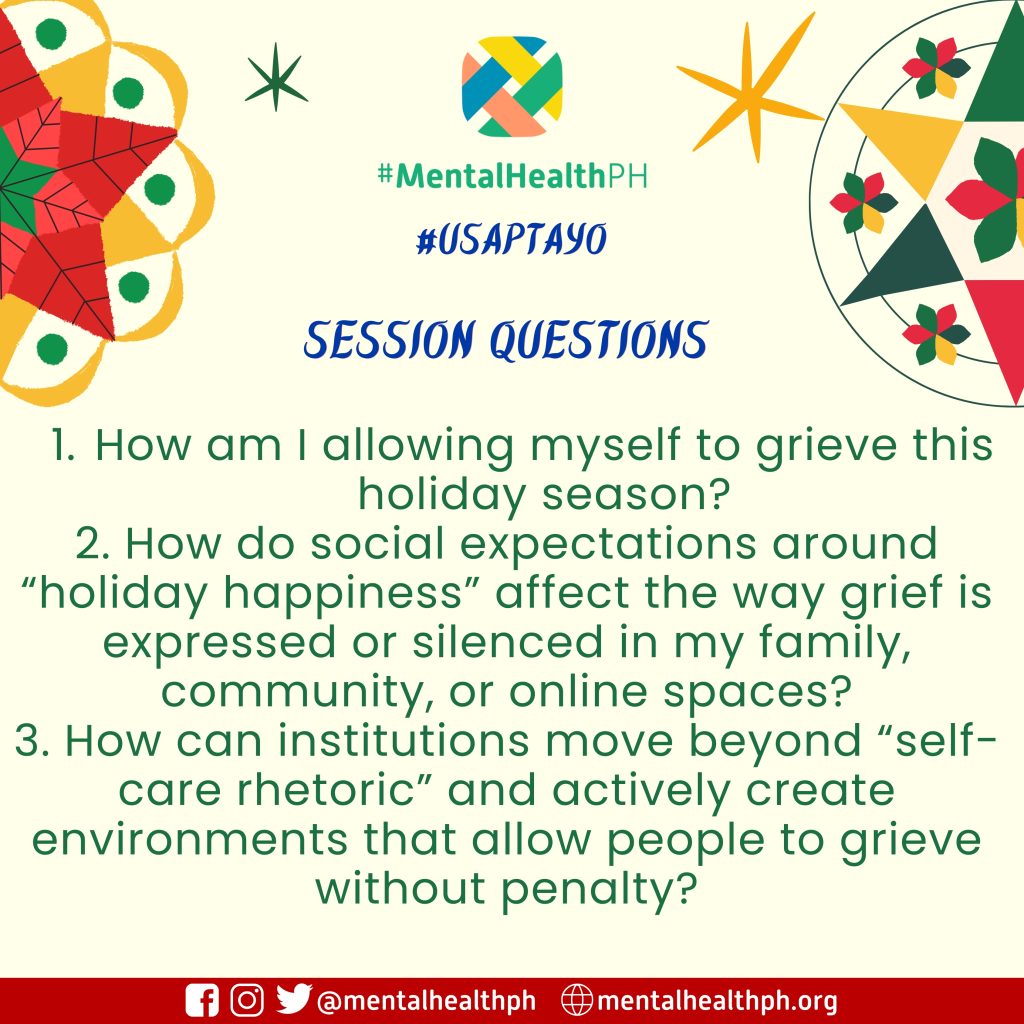
Session Questions:
- How am I allowing myself to grieve this holiday season?
- How do social expectations around “holiday happiness” affect the way grief is expressed or silenced in my family, community, or online spaces?
- How can institutions move beyond “self-care rhetoric” and actively create environments that allow people to grieve without penalty?