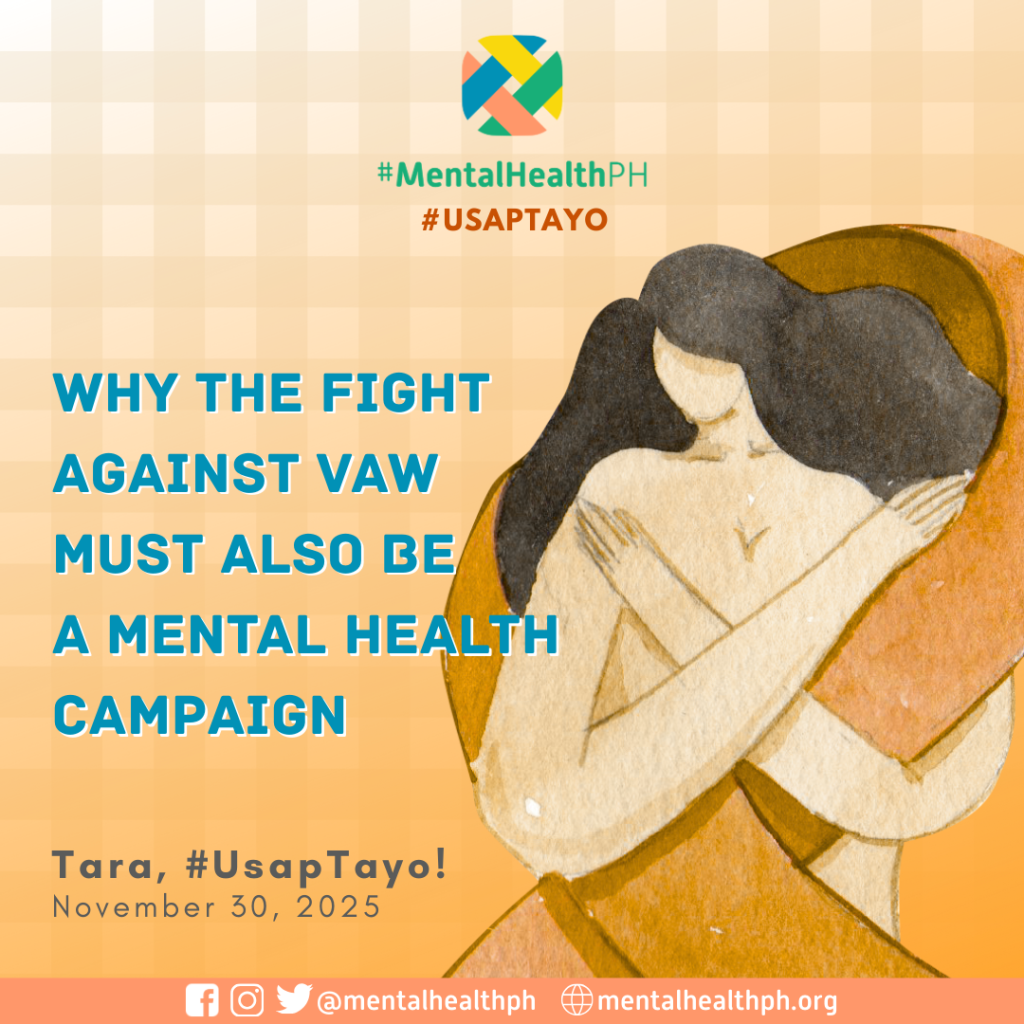
November 30, 2025
Writer and Researcher: Valerie Rose V. Ferido
Every year, thousands of Filipinas survive violence — but many never recover from the invisible wounds it leaves behind. In conversations about gender-based violence, we talk about bruises, legal battles, and safety plans. What we often fail to confront is the more profounddeeper truth: every act of violence against women is also an assault on mental health. And if our advocacy work does not address this reality, we are only treating half of the problem.
Every case of violence against women carries two forms of harm: the visible injury and the invisible one. The second one — the wound inside the mind — is often left untreated.
For many Filipinas, violence doesn’t end when the door slams shut or the police report is filed. The psychological aftermath lingers: fear lodged inside the body, anxiety looping for months, depression creeping into daily life, or trauma replaying in ways that feel inescapable.
Yet despite these realities, we still treat violence against women (VAW) primarily as a legal matter. We talk about evidence, complaints, and restraining orders. But rarely do we ask:
“Kumusta ang isip niya?”
“Kumusta ang puso niya?”
“Is she emotionally safe now?”
This is why VAW must also be a mental health campaign — one that supports individuals, mobilizes communities, and transforms institutions.
Violence deeply alters a woman’s mental landscape
Physical wounds heal. Psychological ones often don’t — not without support.
Women who experience violence frequently report [1] [2]:
- Difficulty trusting, sleeping, or forming relationships
- Self-esteem erosion
- Dissociation and anhedonia
- Chronic fear and hypervigilance
- Panic attacks and flashbacks
- Depression, Anxiety, and suicidality
- Post-traumatic stress disorder (PTSD)
VAW is not only a violation of the body; it is a systemic assault on a woman’s inner world. Every panic attack, every dissociative episode, every night she cannot sleep because she’s replaying threats in her head is a reminder of how deeply violence infiltrates her psychology. And yet our institutions — from barangay desks to police stations to courtrooms — still behave as if healing begins with blotters and medico-legal reports.
It doesn’t.
Healing begins with safety, validation, and psychological support.
Mental health must be part of the anti-VAW response
Philippine advocacy groups, shelters, and barangay VAW Desks do critical work. But the reality is that mental health services remain inaccessible, underfunded, or absent altogether in most anti-VAW interventions.
Women don’t get immediate psychological support — not in a country where mental health care is underfunded and gender-sensitive crisis workers are scarce.
VAW is both a public health emergency and a mental health emergency. It is reinforced by systems that fail to protect women’s inner lives as fiercely as their bodies.
To fully support survivors, we need:
- Mandatory trauma-informed training for police, social workers, and barangay authorities
- Immediate mental health first aid with trained responders who recognize trauma reactions
- Accessible long-term mental health services in every LGU, integrated directly into VAW response
Because when a woman is violated, her mind becomes a battleground long before any case reaches court. A bruised arm can heal in weeks; a shattered sense of safety can take years.
Ending VAW means fighting for a world where women’s psychological pain is not minimized, ignored, or politicized out of existence. It means building systems that protect not only women’s bodies — but their minds, their futures, and their ability to feel whole again.
Violence Against Women is a mental health emergency.
Naming it as such is the first step.
Responding with compassion, resources, and political will is the next.

Session Questions
- How can you take care of your own mental health — or support a friend’s — if you notice signs of trauma caused by violence or abuse?
- What small actions can your community take to create safer, more compassionate spaces for survivors of violence?
- What changes do you believe institutions (schools, barangays, workplaces, LGUs) should implement to support survivors’ mental health betterto better support survivors’ mental health?
References
[1] Office on Women’s Health
2015
Effects of violence against women
https://womenshealth.gov/relationships-and-safety/effects-violence-against-women
[2] Women’s Advocates
2020
Mental Health and Domestic Violence
https://wadvocates.org/find-help/about-domestic-violence/mental-health-and-domestic-violence/