November 30, 2023
Writer/ Researcher: Kyra Ballesteros
Graphics: Jia Moral, Krystle Labio, Ian Stephen Velez

(source: https://www.aljazeera.com/wp-content/uploads/2023/11/INTERACTIVE-LIVE-TRACKER-GAZA-NOV27-2023-0500GMT_INTERACTIVE-LIVE-TRACKER-GAZA-1080-x1080-1701062636.jpg?w=770&quality=80)
Qatar-based news network Al Jazeera’s live counter of the Israel-Gaza war charts the devastating effects of the conflict on Palestinian lives. As this article is written, Al Jazeera reports that 14,854 Palestinians have been killed in Gaza. This astonishing, terrible number includes the deaths of 6,150 children and 4,000 women. Meanwhile, the tally of those who have been injured in the crossfire stands at 36,000 people. From the Occupied West Bank, at least 55 children have been killed. As of November 28, the initial four-day ceasefire has been extended, with an additional extension to the truce sought by Qatar as the mediating body. Since the conflict erupted on 7 October 2023, Filipinos have joined much of the world in witnessing a conflict escalate into a humanitarian disaster, risking the safety, lives, livelihood, and the future of Palestinians in Gaza.
Israel’s continued assault on Gaza and its largely civilian population has created urgent medical emergencies for over 29,000 individuals. Prior to the current ceasefire, current news on the ground and the harrowing personal narratives broadcasted from the Gaza strip can not contain the urgency of providing all forms of aid, including specialized mental health and psychosocial services. According to Medicins du Monde, vulnerable populations – including children, the elderly, persons with disabilities, and women – are at higher risk of psychological suffering and distress [2]. Humanitarian groups have begun to call for a comprehensive response to the crisis, one that includes the provision of evidence-based psychological interventions in order to prevent long-lasting trauma for millions of Gazans [2]. For children in Gaza, at least limited psychological interventions are available to help support their mental wellbeing in the wake of displacement, and experiencing the loss of their loved ones. In a hospital in Gaza, therapeutic interventions are necessary psychological aid to address the traumatic effects of the war on children [5]. Along with a safe shelter, food, and contact to families outside of Gaza, psychological services are beginning to be recognized as a ‘critical component of humanitarian assistance in Gaza’ [2].
Exposure to coverage about traumatic events, including the current war, has become part of the media landscape. For those of us witnessing the developing conflict between Hamas and Israel, the active displacement of millions of Palestinians, and the response of the international community, our relationship with the recent conflict will have been mediated by social media as much as by traditional news coverage. For Filipinos, our relationship with the current conflict may be more immediate and more complicated. When the Philippine government abstained from casting a vote at the United National General Assembly’s non-binding call for a humanitarian ceasefire in Gaza on 27 October 2023, it shone a spotlight on the Philippines and its relationship with Israel, sparking demonstrations to protest the national position.
However, exposure to news and violent images adversely affects individual mental health. Prolonged exposure can even cause distress [1]. It might feel like we cannot look away or as though we are compelled to bear witness to the war [1]. It is important to keep in mind that remaining informed about the current conflict, engaged in discussions about our history, and critical of disinformation does not have to come at the expense of individual wellbeing and mental health.
The following strategies can help individuals remain mentally healthy as we encounter more news coverage about conflicts at home and abroad:
- Reduce exposure to upsetting news and imagery by setting only a length of time or a set schedule for reading the news;
- Redirect attention [1] to something else to prevent prolonged exposure to disturbing or distressing content;
- Notice how you feel and get support when needed. Pay attention to your body, and give yourself a break before you feel distressed [3];
- Opt for words instead of images or videos wherever possible [3];
- And give yourself a chance to recharge [3].
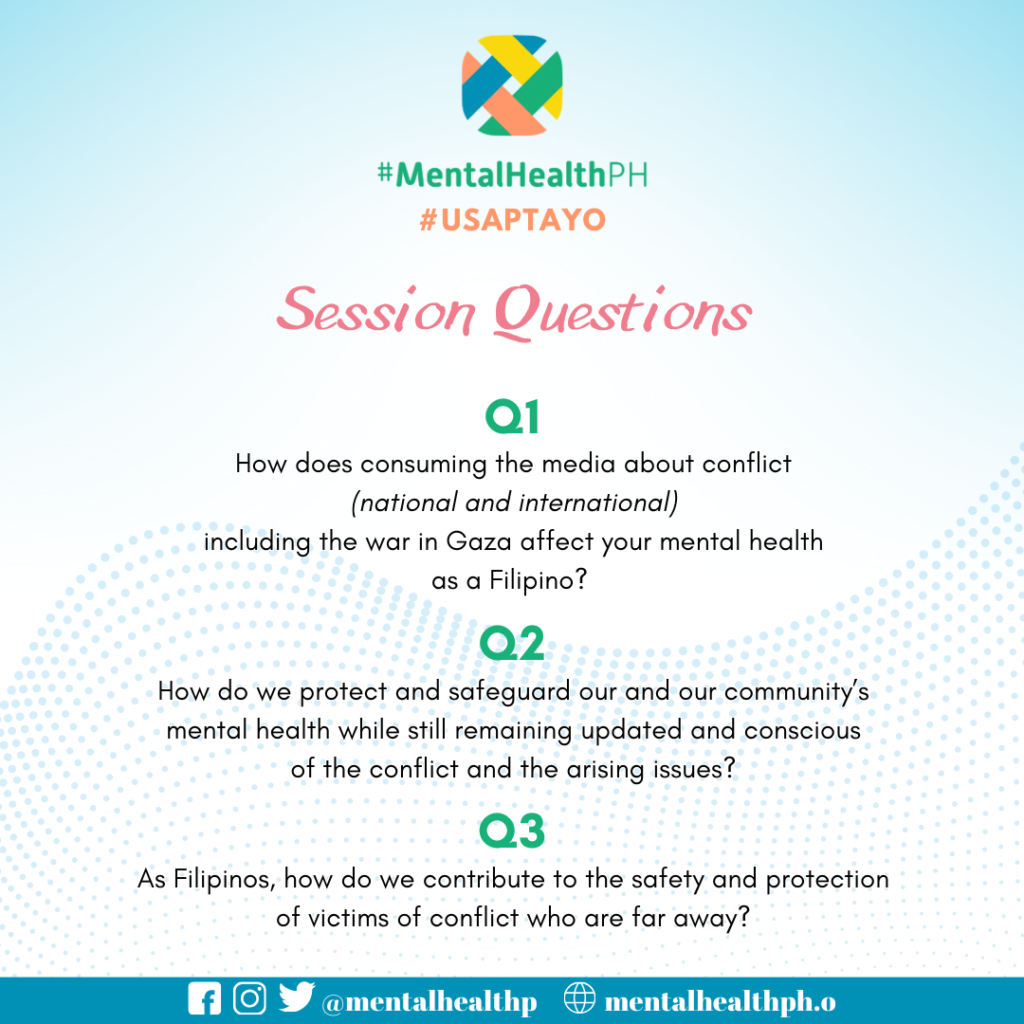
Join us this 30th as we talk about keeping mentally healthy even as we read about conflict. Tara, #UsapTayo!

Guide Questions:
- How does consuming the media about conflict (national and international) including the war in Gaza affect your mental health as a Filipino?
- How do we protect and safeguard our and our community’s mental health while still remaining updated and conscious of the conflict and the arising issues?
- As Filipinos, how do we contribute to the safety and protection of victims of conflict who are far away?
WORKS CITED:
[1] Gharib, M. (2023, November 24). Watching war unfold is distressing – here’s how to protect your mental health. NPR. https://www.npr.org/sections/health-shots/2023/11/24/1214534579/images-war-gaza-israel-vicarious-trauma-stress
[2] The mental health impact of the war in the Gaza Strip. Médecins du Monde. (2023, November 24). https://www.medecinsdumonde.org/en/news/the-mental-health-impact-of-the-war-in-the-gaza-strip/
[3] Shrikant, A. (2023, October 13). What does watching violence do to your mind? “nothing good”: 5 tips for maintaining your mental health while following the news. CNBC. https://www.cnbc.com/2023/10/13/tips-for-following-the-news-while-taking-care-of-your-mental-health.html
[4] Beltran, M. (2023, October 31). “blood on its hands”: Filipinos slam gov’t abstention on UN gaza resolution. Al Jazeera. https://www.aljazeera.com/news/2023/10/31/filipino-protesters-slam-govt-abstention-on-israel-gaza-resolution-at-un
[5] Humaid, M. (2023, November 21). “no end in sight”: Gaza’s traumatised children need psychological aid. Al Jazeera. https://www.aljazeera.com/news/2023/11/20/no-end-in-sight-gazas-traumatised-children-need-psychological-aid
[6] Ducharme, J. (2022, March 8). Watching war unfold on social media affects mental health. Time. https://time.com/6155630/ukraine-war-social-media-mental-health/