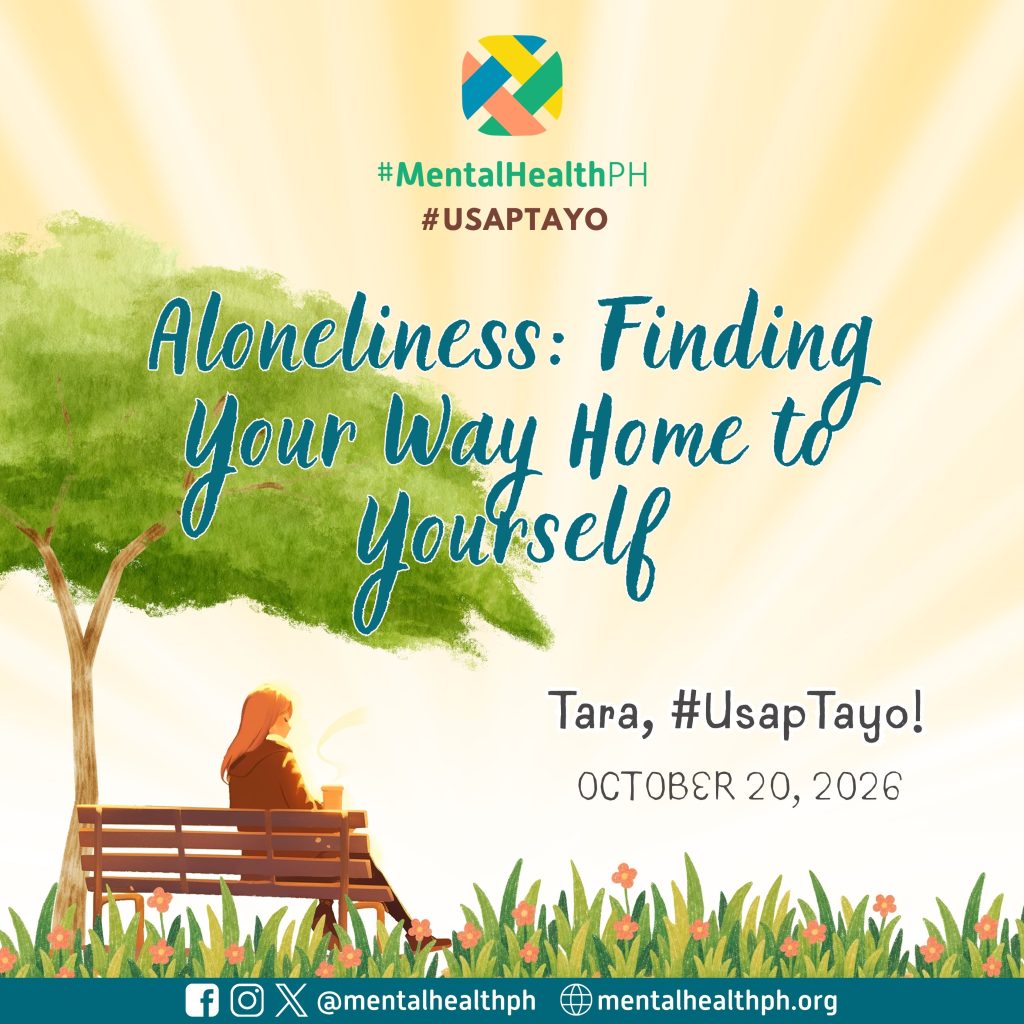
October 20, 2026
Writers: Glory Tangarorang, Kevin Miko Buac
Creatives: Jia Moral, Krystle Mae Labio
There is a kind of silence that heals.
The silence after a difficult conversation. The stillness of the room where you can finally breathe. Or the moment you stop trying to explain yourself to those who have never tried to understand. Sometimes we need to step away from the noise to remind ourselves of the one voice we’ve neglected to hear for far too long: our own.
Aloneliness, a term in psychological research that describes the discomfort of not getting enough time alone [1]. I found myself reflecting on a different, more personal idea instead: a quiet presence and comfort of one’s own company without mistaking solitude for loneliness. Not a medical term nor a scientific explanation to a growing problem, but an introduction to the ways solitude can heal us if we let it.
We live in a world that often measures our worth by how well we fit in, how much we accomplish, and how readily we make ourselves understood by others. But sometimes, we lose sight of the one place we should never have to earn our belonging: within ourselves.
Coming home to yourself is a process of learning to listen to your feelings without immediately judging them. Knowing that you can both feel grateful and grieving, hopeful and hopeless, surrounded by people and still feel alone, it’s learning how to deal with these contradictions. You do not have to feel the need to turn every wound into wisdom or every disappointment into a lesson. Sometimes, healing begins simply by allowing yourself to be human.
But solitude should never be a punishment or a sentence we have to serve because the world has made us afraid to speak.
Loneliness is not a personal shortcoming, not in the way it’s typically perceived. The World Health Organization (WHO) has identified social connection as key to our overall health and well being, and loneliness as detrimental to both our mental and physical health [2,3]. Mental health is shaped by a range of individual, social, and structural factors [4]. People need people and we need each other to survive, not because we are somehow lesser without others, but because being heard, understood, and supported is all part of being human.
Which is why home is the friend who listens to your problems without rushing to fix them. It is the family who makes space within themselves to hold a truth you can’t yet hold on your own; home is the community that replaces shame with understanding; and it is the professional who reminds you that asking for help is a sign of strength, not weakness. Home is also the courage it takes to say “I am struggling”, and to know that it’s okay to need people to help you carry your burdens. Home is “I’m sorry” and “Tell me what I can do”.
This World Mental Health Month, I hope we can all learn to listen more closely to the people in our lives. To hear them, truly hear them in the way that they need to be heard. Without judgment or dismissal or comparison, believing them when they say they’re hurting, asking what we can do to help, and using our voices to turn their pain into something beautiful and healing. Because that is what home is.
If you’re still searching for a place where you belong, I hope you find people who make you feel safe being who you are. Until then, may you always learn to meet yourself with the same tenderness and compassion you would offer someone you love [5].
It’s okay to take a breather.
It’s okay to choose to restart.
It’s okay to ask for help.
And when the world feels too loud, you can always pause, breathe, and find your way back to yourself.
Because home is not always where the hurt ends. Sometimes, it is where we feel most at peace with who we are, and finally feel safe to tell our story.
You are home. Your story belongs here. And your voice deserves to be heard.
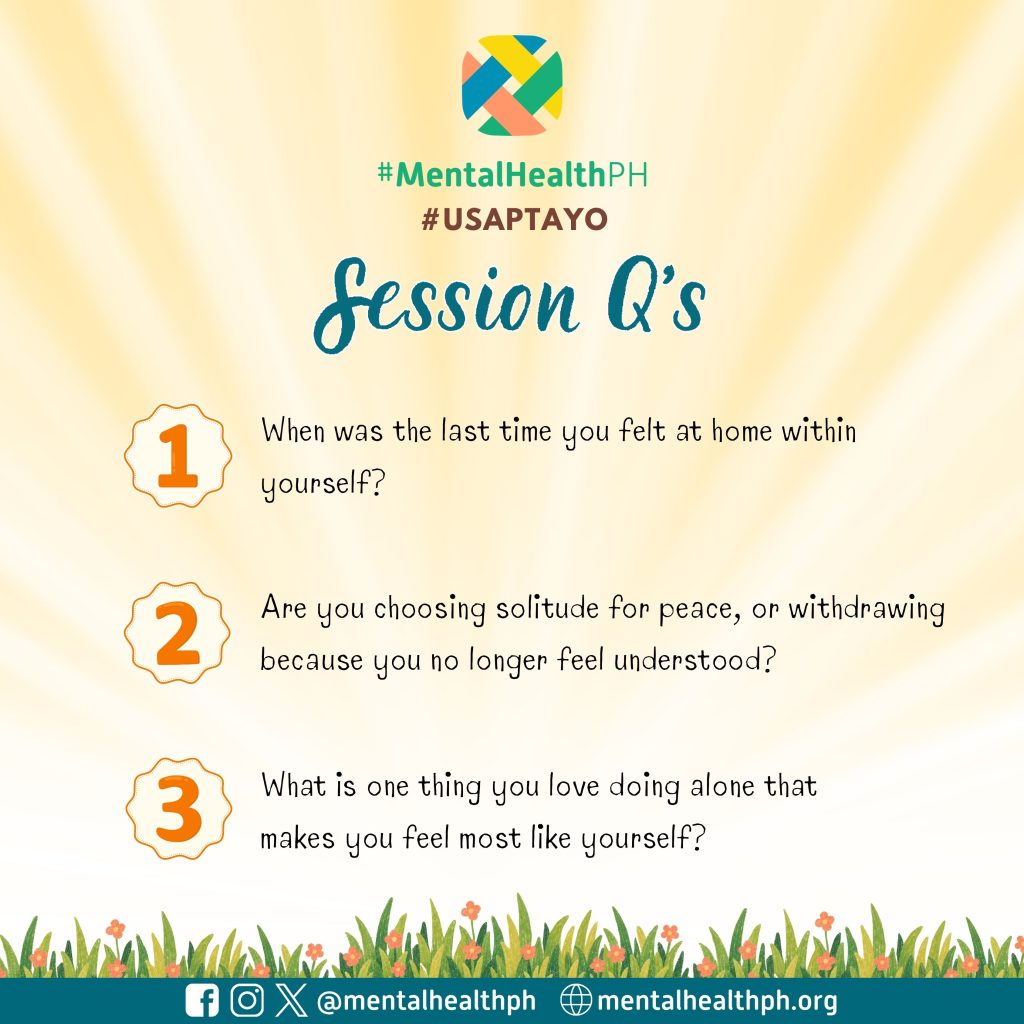
Session Questions:
- When was the last time you felt at home within yourself?
- Are you choosing solitude for peace, or withdrawing because you no longer feel understood?
- What is one thing you love doing alone that makes you feel most like yourself?
References:
- Coplan RJ, Hipson WE, Archbell KA, Ooi LL, Baldwin D, Bowker JC. Seeking more solitude: conceptualization, assessment, and implications of aloneliness. Pers Individ Dif. 2019;148:17-26. doi:10.1016/j.paid.2019.05.020.
- World Health Organization. Social connection [Internet]. Geneva: World Health Organization; 2025 Jun 30 [cited 2026 Oct 10]. Available from: https://www.who.int/news-room/questions-and-answers/item/social-connection
- World Health Organization. From loneliness to social connection: charting a path to healthier societies [Internet]. Geneva: World Health Organization; 2025 Jun 30 [cited 2026 Oct 10]. Available from: https://www.who.int/groups/commission-on-social-connection/report/
- World Health Organization. Mental health [Internet]. Geneva: World Health Organization; 2026 Sep 11 [cited 2026 Oct 14]. Available from: https://www.who.int/news-room/fact-sheets/detail/mental-health-strengthening-our-response
- Neff KD. Self-compassion: theory, method, research, and intervention. Annu Rev Psychol. 2023;74:193-218. doi:10.1146/annurev-psych-032420-031047.