Writer and Researcher: Valerie Rose V. Ferido
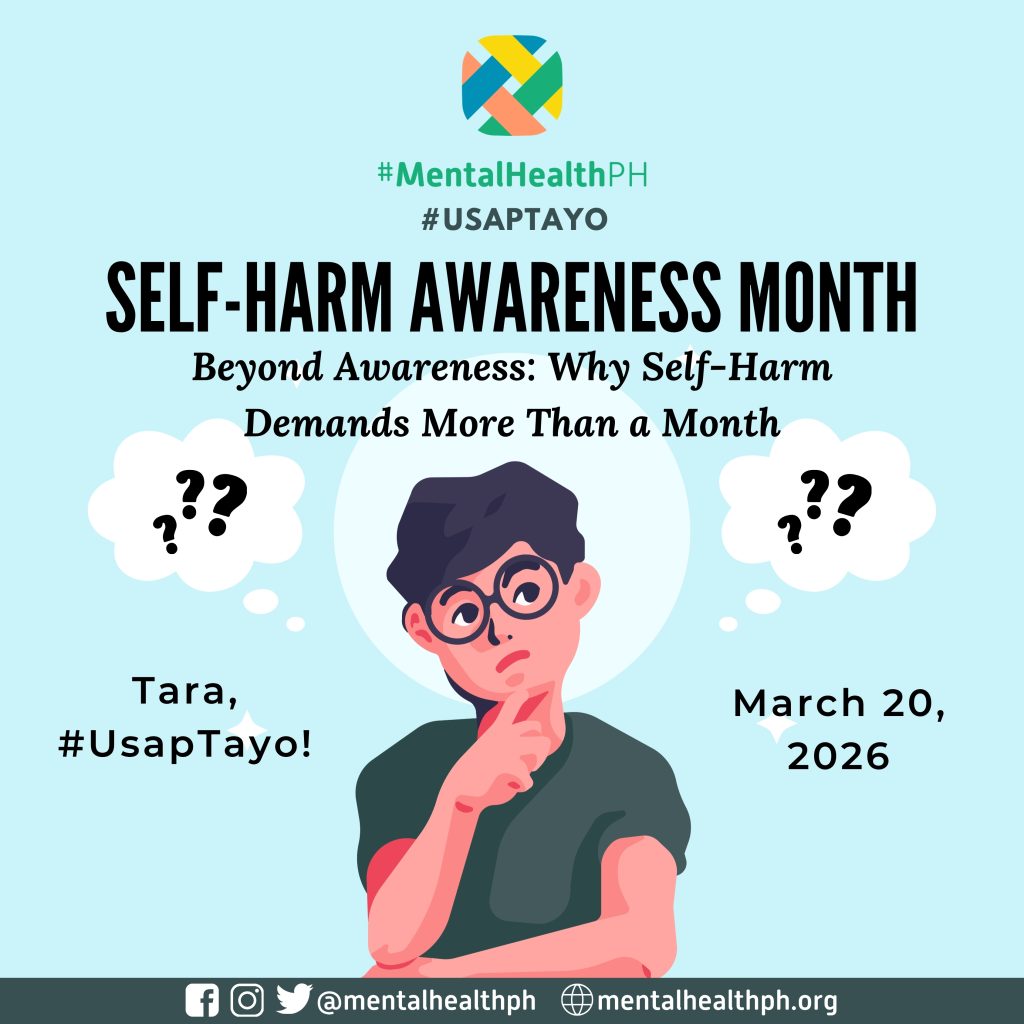
Every year, Self-Harm Awareness Month arrives with a familiar rhythm. Infographics flood timelines, helpline numbers are reposted, and institutions release carefully worded statements about care and compassion.
For a moment, the conversation opens.
And then, just as quickly, it closes.
Because awareness—while necessary—is also the safest place to stop. It allows us to acknowledge pain without interrogating its causes, to express empathy without demanding accountability, to name suffering without addressing the systems that produce it.
But self-harm does not operate on a calendar. It persists long after the posts disappear—in the quiet, in the unseen, in the lives of people who are left to carry more than they can hold.
To frame it as a seasonal issue is to misunderstand it entirely.
Because self-harm is not just about awareness. It is about the conditions that make survival feel unbearable—and the systems that fail to respond.
The question, then, is not simply whether we are paying attention.
It is this: who gets to heal—and who is left to cope alone?
Self-Harm Is Not a Moral Failure
Before anything else, we need to dismantle the most persistent and harmful myth:
that self-harm is a sign of weakness, attention-seeking, or lack of faith.
It is not.
Self-harm is a coping mechanism—one that emerges when emotional distress becomes overwhelming and uncontainable. It is often less about wanting to die, and more about wanting relief. Control. Release. Silence.
For many, it is the only language available when pain has been repeatedly dismissed.
To reduce it to “papansin” or “drama” is not only inaccurate; it is deeply harmful. It reflects a broader culture that invalidates emotional suffering unless it is visible, severe, or convenient to acknowledge. In doing so, it pushes people further into silence, making it harder—not easier—for them to seek help.
And in that silence, the harm is not just misunderstood.
It is allowed to continue.
When Systems Produce the Very Distress They Ignore
It is easy—convenient, even—to frame self-harm as an individual issue.
But doing so obscures a harder truth:
Many of the conditions that lead to self-harm are structural.
Consider the realities many Filipinos navigate daily:
- An education system that equates worth with productivity, pushing students into chronic burnout
- Work cultures that glorify overwork while offering little security or support
- Economic instability that forces individuals into survival mode, leaving little space for emotional well-being
- Social expectations that demand resilience without providing resources for recovery
These are not isolated stressors. They are systemic pressures.
And yet, when individuals break under their weight, the responsibility is placed solely on them.
They are told to cope better.
To seek help.
But what happens when help is inaccessible?
The Illusion of Accessible Mental Healthcare
The Mental Health Act of 2018 (RA 11036) was hailed as a milestone—a commitment to making mental healthcare more accessible and affordable.
But nearly a decade later, that promise remains unevenly fulfilled.
In reality:
- Public mental health facilities are limited and often under-resourced
- The ratio of mental health professionals to the population remains critically low
- Therapy, especially in private settings, is financially out of reach for many Filipinos
- Crisis hotlines exist, but awareness and consistency in access vary
Mental healthcare, in the Philippines, is still largely a privilege.
And when access depends on financial capacity, geography, and awareness, recovery becomes stratified.
Those who can afford care heal differently—and often more safely—than those who cannot.
What It Actually Means to “Check on Your Loved Ones”
“Check on your loved ones” has become a common refrain during awareness campaigns.
But what does that actually look like in practice?
It is more than sending a message that says, “Are you okay?”
It is:
- Creating space for honest answers—even when they are uncomfortable
- Listening without immediately offering solutions or judgment
- Taking distress seriously, even when it is not visibly extreme
- Staying present, especially when it would be easier to withdraw
Checking in is not a one-time act. It is an ongoing commitment.
Because for someone struggling with self-harm, consistency can mean the difference between isolation and connection.
Awareness Is Not Enough
If Self-Harm Awareness Month is to mean anything beyond visibility, it cannot end with posts, slogans, and temporary concern. Awareness, on its own, is passive. It names the problem without disrupting the conditions that produce it. It allows institutions to appear responsive while remaining fundamentally unchanged.
What is needed is not just recognition, but redistribution—of resources, of priorities, of responsibility. This means sustained investment in mental healthcare infrastructure, not just during crises but as a long-term commitment. It means policies in schools and workplaces that treat well-being as essential, not secondary to productivity. It demands community-level efforts that actively dismantle stigma, rather than quietly perpetuating it through dismissal and silence. It requires cultural shifts that allow vulnerability to exist without punishment, ridicule, or moral judgment.
Without these changes, awareness becomes ritualistic—something we perform annually to signal care, only to return to systems that continue to produce the very distress we claim to recognize. And in that cycle, nothing truly changes except the language we use to describe the same, unresolved harm.
Self-harm is not confined to a single month, and neither should our attention be. Awareness is only the first step—real change requires ongoing conversation, sustained support, and a willingness to challenge the systems that leave people struggling alone. Check in with those around you, listen without judgment, and keep the dialogue alive. Only by making these conversations continuous can we begin to create a culture where healing is possible for everyone.
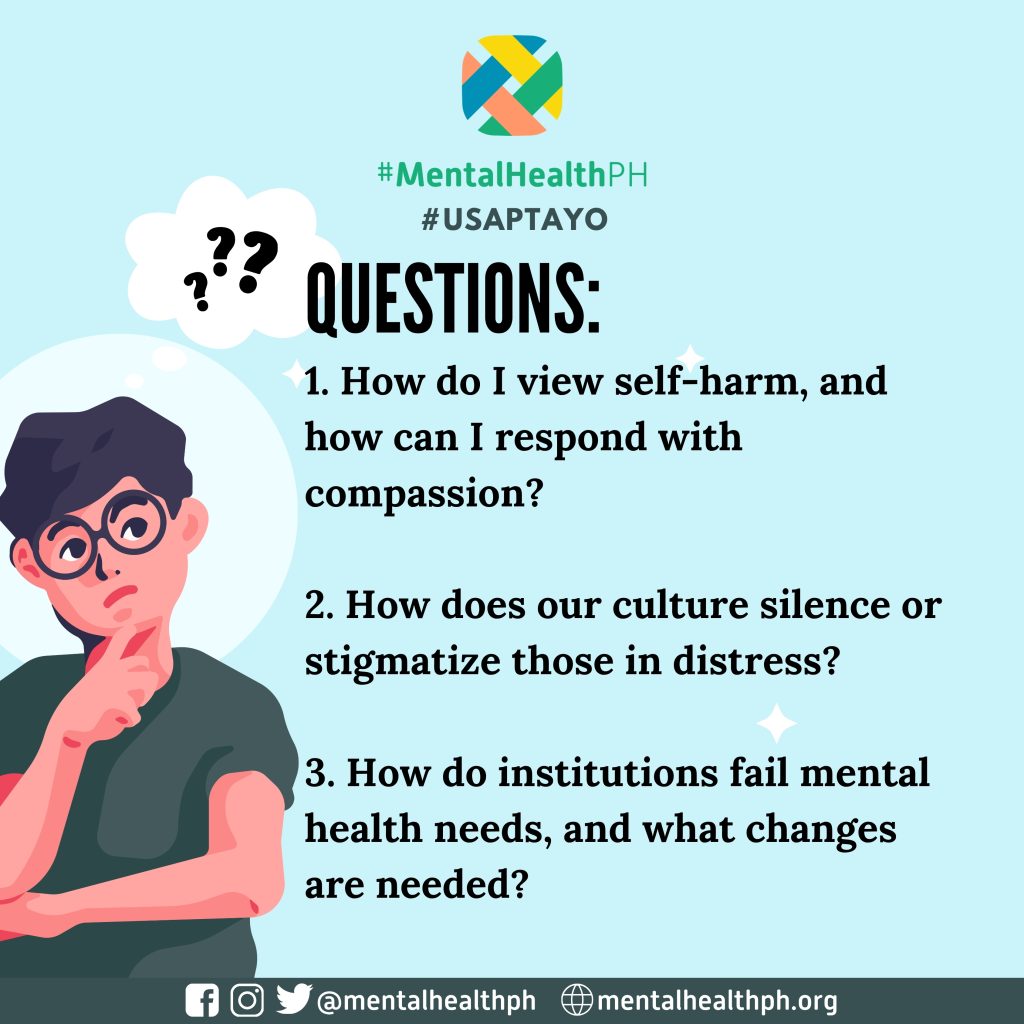
Session Questions
- How do I view self-harm, and how can I respond with compassion?
- How does our culture silence or stigmatize those in distress?
- How do institutions fail mental health needs, and what changes are needed?