March 10, 2026
Women’s Month is often a celebration of achievements, leadership, and resilience. Yet behind these narratives of strength is a quieter but equally powerful act of empowerment: the ability of women to set healthy boundaries. In many societies, including the Philippines, women are often expected to be endlessly giving—balancing professional responsibilities, caregiving roles, emotional labor, and community obligations. While these roles reflect dedication and care, the expectation to “do it all” can also place women at risk of stress, burnout, and diminished well-being.
Boundaries are essential to maintaining mental health. Psychological research shows that individuals who establish clear personal boundaries experience greater emotional regulation, reduced stress, and healthier interpersonal relationships (Cloud & Townsend, 2017). For women, boundary-setting can be particularly transformative because it challenges deeply rooted social norms that equate self-sacrifice with virtue.
Cultural expectations often position women as primary caregivers in both the family and community. Globally, women perform a disproportionate share of unpaid care work, including childcare, eldercare, and household responsibilities (United Nations Women, 2023). While caregiving is a valuable and meaningful role, the imbalance can lead to mental fatigue and limited time for self-care, personal growth, or rest. When women are expected to carry these invisible burdens without support, their mental health can suffer.
Setting boundaries does not mean withdrawing from responsibilities or relationships. Rather, it means recognizing personal limits and communicating them clearly. Boundaries allow women to say “yes” to what aligns with their values while also giving themselves permission to say “no” when demands become overwhelming. Studies on self-compassion and well-being suggest that individuals who prioritize their own needs in balanced ways report higher life satisfaction and lower levels of anxiety and depression (Neff, 2011).
Empowering women to create boundaries also benefits communities. When women are supported in protecting their time, energy, and mental health, they are better able to contribute meaningfully in their workplaces, families, and civic spaces. Empowered women often become advocates, mentors, and leaders who uplift others and model healthier social expectations. In this sense, personal empowerment extends outward—strengthening collective well-being.
Communities and institutions also have a role to play in supporting women’s boundaries. Workplaces can promote flexible policies, equitable workload distribution, and mental health support systems. Families can share caregiving responsibilities more fairly. Schools, media, and community organizations can challenge narratives that glorify exhaustion or self-neglect as proof of dedication. According to the World Health Organization (WHO), supportive environments and equitable social structures are key factors in protecting mental health and promoting gender equality (World Health Organization, 2022).
For #UsapTayo, Women’s Month is an invitation not only to celebrate women’s achievements but also to examine the systems and expectations surrounding them. Empowerment means recognizing that strength includes rest, care, and personal limits. It means validating women’s right to define their own capacities without guilt or judgment.
When women feel empowered to create healthy boundaries, they reclaim agency over their time, energy, and mental well-being. And when women thrive, families grow stronger, workplaces become healthier, and communities become more compassionate and resilient.
This Women’s Month, let us remember: empowering women is not only about amplifying their voices—it is also about respecting their boundaries.
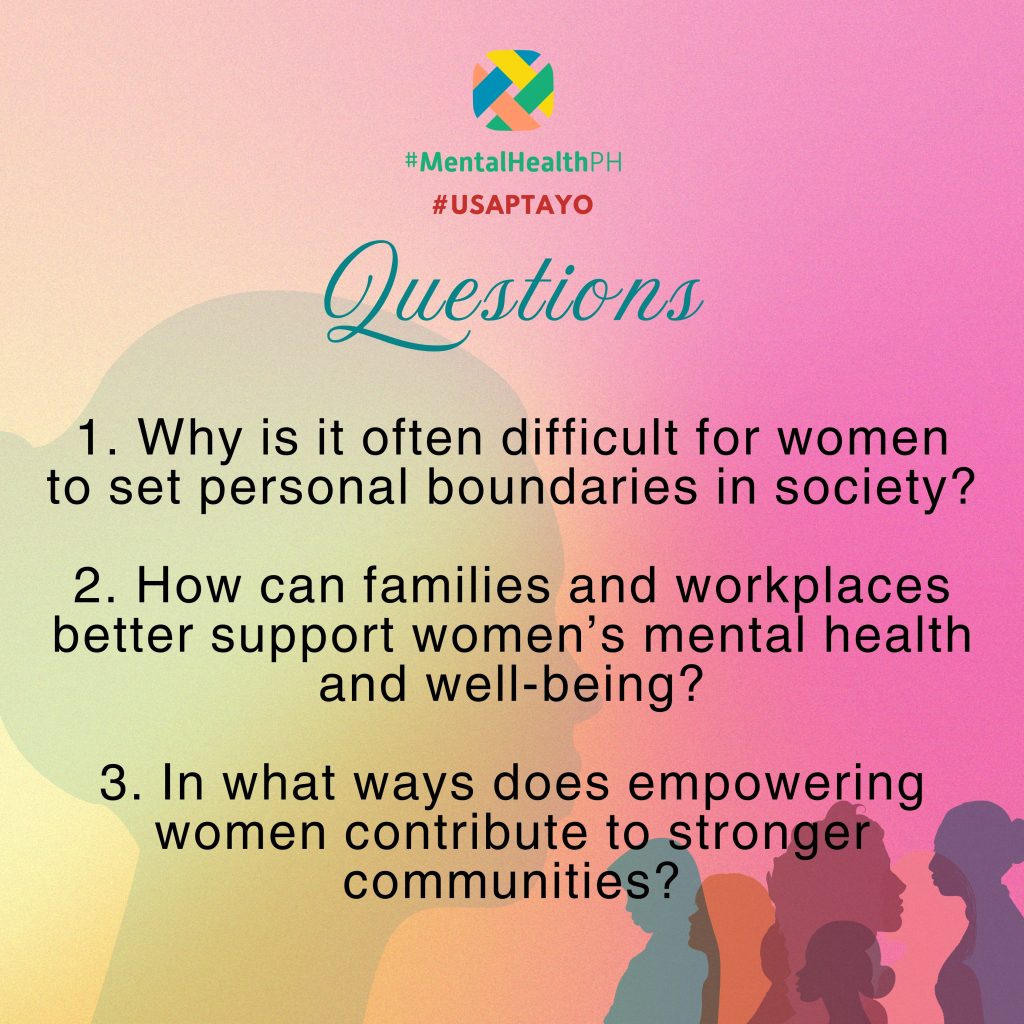
Questions
- Why is it often difficult for women to set personal boundaries in society?
- How can families and workplaces better support women’s mental health and well-being?
- In what ways does empowering women contribute to stronger communities?
References
Cloud, H., & Townsend, J. (2017). Boundaries: When to say yes, how to say no to take control of your life. Zondervan.
Neff, K. D. (2011). Self-compassion: The proven power of being kind to yourself. William Morrow.
United Nations Women. (2023). Progress on the sustainable development goals: The gender snapshot 2023. https://www.unwomen.org
World Health Organization. (2022). Mental health at work: Policy brief. https://www.who.int